
 CN
CN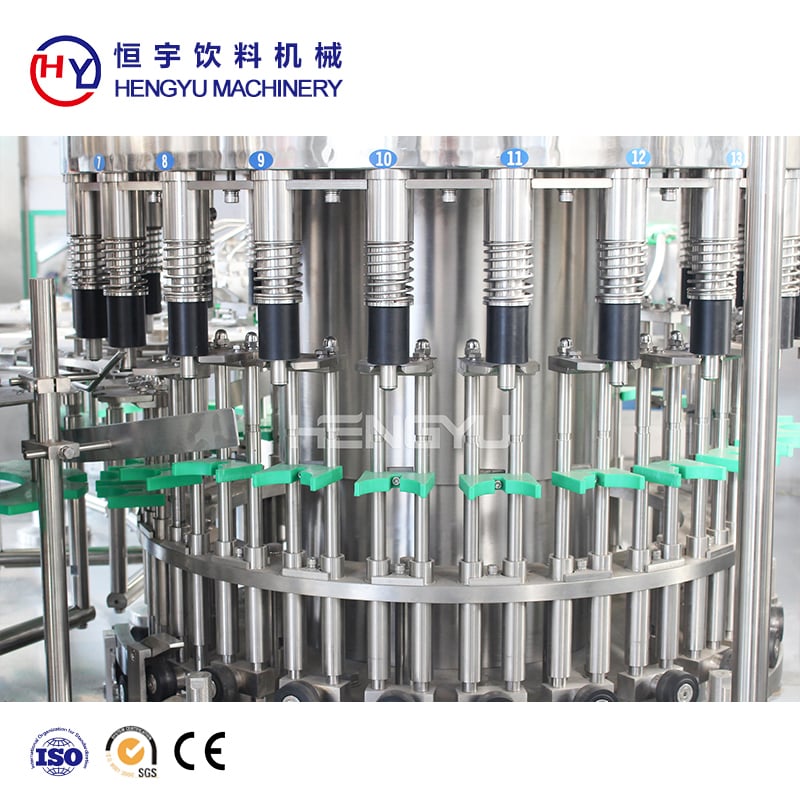
Why Bowl Pressure Stability Is Critical for CO₂ Retention
The Physics Link: How Transient Pressure Disrupts Henry’s Law Equilibrium
Henry’s Law governs CO₂ solubility in carbonated beverages: dissolved gas concentration is directly proportional to the partial pressure above the liquid. In isobaric filling, the filler bowl’s backpressure must match the beverage’s saturation pressure—typically 2.5–3.5 bar—to maintain equilibrium and retain CO₂ in solution. Even a momentary 0.3-bar drop can force dissolved CO₂ out of equilibrium, causing up to 15% carbonation loss (Ponemon 2023). The bowl serves as the system’s pressure reservoir; transient fluctuations—whether from valve cycling, line-speed changes, or gas supply surges—disturb this equilibrium at the fill nozzle. Modern dual-stage pneumatic regulators and PID-controlled gas reservoirs actively suppress such micro-deviations. When stability is maintained within ±0.05 bar, the liquid-gas interface remains calm, suppressing bubble nucleation and foam formation. This precision ensures every bottle enters the fill cycle under identical thermodynamic conditions—locking in the target CO₂ volume.
Empirical Impact: Correlating ±0.02 bar Fluctuations with Measured CO₂ Loss in High-Carbonation CSD Lines
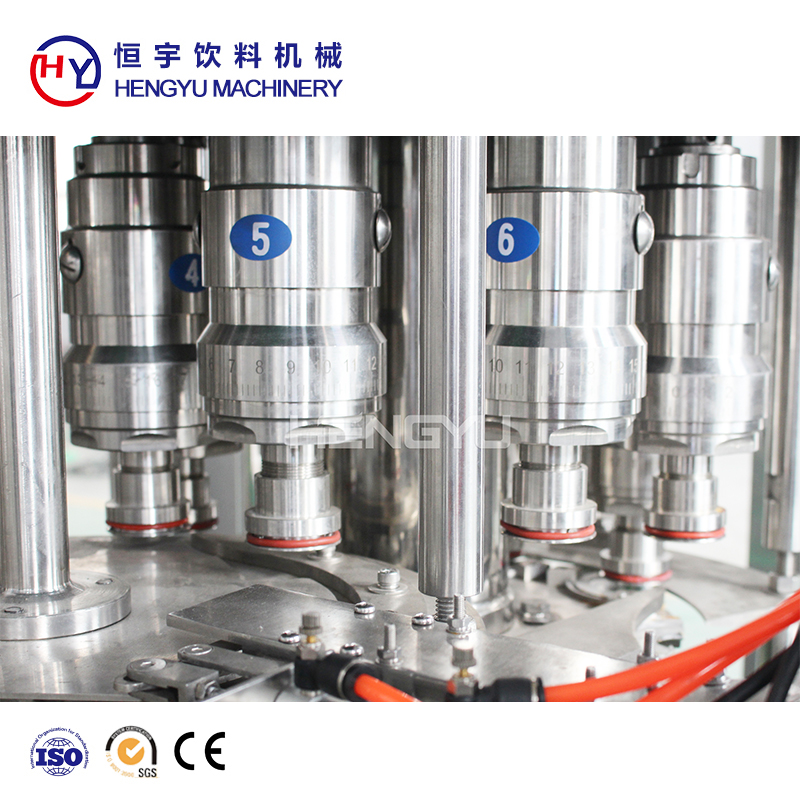
High-speed carbonated soft drink (CSD) lines operating at 600 bottles per minute demonstrate how minuscule pressure deviations erode product quality. A 2023 bottling study found that systems holding bowl pressure within ±0.1 bar achieved dissolved CO₂ variance of just 0.15 g/L. Yet when fluctuations narrowed to ±0.02 bar—a deviation often assumed negligible—measurable divergence from specification emerged at the filler outlet. These micro-variations compound over thousands of fills, resulting in inconsistent mouthfeel and increased rejection rates for under-carbonated units. Real-time pressure mapping paired with multi-stage gas injection has proven effective at detecting and correcting such deviations before they propagate downstream. The data confirm that true bowl pressure stability isn’t merely a tolerance band—it’s a tightly controlled constant. Even the smallest ripple disrupts Henry’s Law equilibrium and degrades CO₂ retention at scale.
Process Control Strategies for Reliable Bowl Pressure Stability
Dual-Stage Pneumatic Regulation and PID Tuning Best Practices
Precise bowl pressure control depends on dual-stage pneumatic regulation: two cascaded pressure-reducing valves absorb upstream disturbances before they reach the filler. The first stage performs coarse reduction of incoming plant air; the second delivers fine-tuned adjustment near the 2–4 bar operating range. This architecture cuts pressure ripple amplitude by over 40% compared to single-valve systems. Complementing this hardware, a well-tuned proportional-integral-derivative (PID) controller is essential to accommodate the bowl’s slow thermal and pneumatic response. Overly aggressive integral action induces oscillation; insufficient integral gain leaves steady-state offset. An auto-tuned PID loop with a 0.5-second derivative filter—validated across six high-speed CSD lines in a 2022 audit—maintained bowl pressure within ±0.008 bar, keeping excursions well below the ±0.02 bar threshold linked to CO₂ breakout (2022 Beverage Process Engineering Report). Operators should log both PID output and pressure signals for trend analysis, as actuator hysteresis often masks developing drift. Routine bump-less transfer testing between duty and standby regulation paths further ensures control-loop integrity after maintenance.
Mitigating Ambient Temperature Drift in Filler Bowl Manifolds
Ambient temperature shifts affect gas density and strain-gauge transmitter calibration, introducing slow, insidious drift into the bowl pressure signal. A 5 °C rise in manifold temperature can induce a 0.03-bar fictitious offset due to stainless-steel expansion altering sensor zero points. Insulating manifold piping and shielding it from heat sources—such as nearby bottle-warmers—reduces thermal influence. More critically, temperature-compensated pressure sensors must be selected, and the transmitter’s reference leg positioned in the same thermal environment as the bowl. A 2023 plant-floor correlation study showed active temperature compensation reduced drift-induced error from 0.04 bar to 0.006 bar across a 10 °C ambient cycle—enabling the isobaric filler to sustain CO₂ retention within 0.1 g/L of recipe targets (2023 Filler Reliability Consortium). Integrating temperature monitoring directly into the pressure control loop is thus a low-cost, high-impact safeguard.
Validating CO₂ Retention Through Real-Time Monitoring and Line Audits
Dissolved CO₂ Measurement at Fill Nozzles: Diagnostic Insights from a 32-Valve CSD Line
Real-time dissolved CO₂ measurement at individual fill nozzles provides a direct diagnostic window into bowl pressure stability during isobaric filling. On a 32-valve CSD line, even subtle pressure deviations—caused by regulator lag or thermal drift—disrupt Henry’s Law equilibrium and trigger premature CO₂ breakout before capping. Inline infrared sensors at each nozzle map retention variability across the filler index. During one audit, valves 12–16 delivered 0.15 vol less CO₂ than target—directly correlating with a 0.02 bar pressure dip traced to suboptimal PID tuning. Real-time monitoring enabled immediate correction: adjusting proportional gain reduced dissolved CO₂ standard deviation from 0.12 to 0.04 vol. Cross-referencing nozzle-level CO₂ data with synchronized bowl pressure transducer logs confirms that process control improvements yield measurable, consistent gains in carbonation uniformity. This integration transforms bowl pressure stability from an abstract engineering parameter into a verifiable, actionable quality metric—ensuring every container meets brand specifications.
FAQ Section
Why is bowl pressure stability important for CO₂ retention?
Bowl pressure stability ensures that the dissolved CO₂ remains in equilibrium according to Henry’s Law, preventing loss of carbonation and maintaining beverage quality.
What happens if bowl pressure fluctuates during the filling process?
Pressure fluctuations disrupt equilibrium, leading to CO₂ breakout, inconsistent carbonation levels, foam formation, and increased rejection rates.
How can ambient temperature drift affect bowl pressure stability?
Temperature fluctuations can alter gas density and sensor calibrations, introducing errors and causing pressure instability, which impacts CO₂ retention.
What is the role of dual-stage pneumatic regulators?
Dual-stage pneumatic regulators absorb upstream disturbances and provide precise control, reducing pressure ripples and aiding in maintaining stability within the required range.