
 CN
CN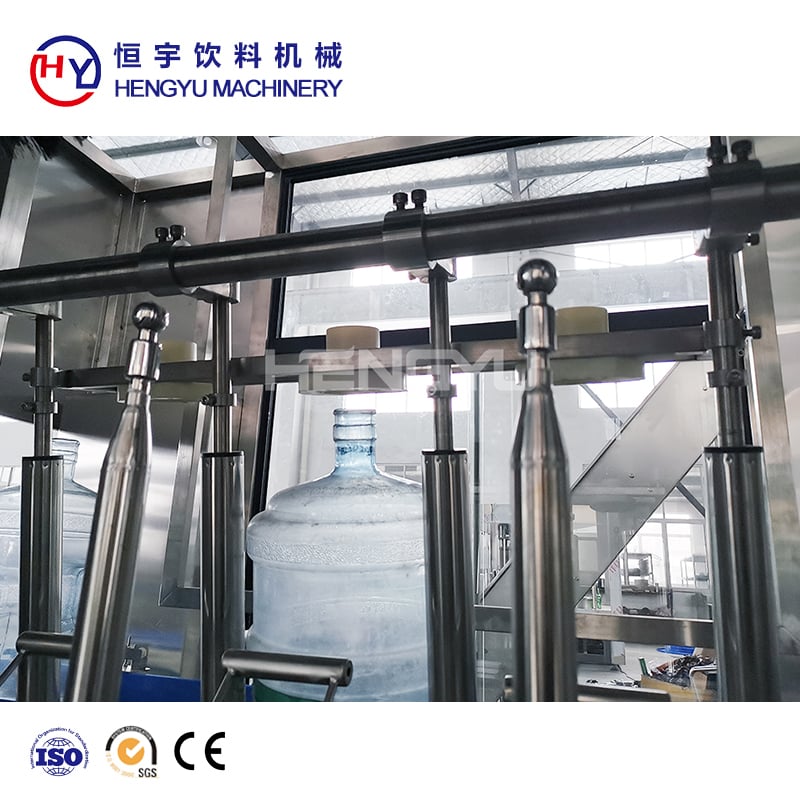
How Cap Fetching Auto Placing 5Gallon Water Automation Enhances Line Efficiency
Modern 5‑gallon water bottling lines must balance speed with uncompromising hygiene. Automatic cap fetching and placing systems directly address the most persistent bottleneck—manual cap handling—by mechanizing the entire feeding cycle and integrating seamlessly with upstream washing and filling modules. This shift not only frees operators from repetitive tasks but also unlocks consistent, high‑speed production.

Eliminating Manual Bottleneck: From Labor-Dependent to Fully Automated Cap Handling
Traditional lines depend on personnel to pick, orient, and mount caps onto filled bottles—a sequence that limits throughput and introduces variability. Fatigue, inconsistent placement, and cap jams are frequent, and a 2023 analysis of bottling facilities found that manual capping contributes to up to 15% of total line downtime (Packaging Technology Report). With automatic cap fetching and placing, the entire feed becomes autonomous. Vibratory bowl feeders or vision‑guided pickers extract caps from bulk, orient them correctly, and position them precisely onto the bottle neck—all synchronized with the filler’s cycle. This eliminates the labor‑dependent bottleneck, enabling one operator to supervise multiple lines while maintaining uninterrupted flow. The system’s ability to handle caps of varying colors and slight dimensional tolerances further reduces reject rates, ensuring every bottle receives a secure cap without manual intervention.
Throughput Optimization: Achieving Stable 12,000 BPH with <0.5% Jam Rate
Sustained speed with minimal interruptions is the true measure of a high‑performance line. Modern automatic cap feeders employ high‑speed servo‑driven pick‑and‑place mechanisms capable of consistently achieving 12,000 bottles per hour. More critically, embedded vision systems and PLC‑coordinated motion control keep jam rates remarkably low. Field data from 2023 upgrades show that properly tuned automation maintains jam rates below 0.5%, even during extended runs. This reliability stems from real‑time cap presence checks, anti‑jam chute designs, and immediate fault recovery that bypasses defective caps without stopping the line. The result is a 15–20% increase in net output compared to manual lines—directly attributable to eliminating micro‑stoppages and sustaining steady cadence. With such low jam rates, overall equipment effectiveness rises, and full line capacity is realized, delivering rapid ROI.
Core Technology Stack: Vision-Guided Feeding, PLC Coordination, and AI-Powered Orientation Correction
Synchronized Vision-PLC Workflow for Real-Time Cap Detection and Positioning
In a Cap Fetching Auto Placing 5Gallon Water Automation system, a high-speed vision module captures each cap’s position and orientation as it moves along the feeder. The PLC interprets this data within milliseconds, triggering servo-driven grippers to adjust placement on the bottle neck. A closed feedback loop compares achieved position with target coordinates, correcting any drift immediately. This eliminates lag and variability inherent in traditional mechanical guides. The result is a single, fluid motion: caps are picked, oriented, and seated with repeatable precision. Bottlenecks caused by misalignment vanish because the system adapts dynamically to production speed changes—no manual recalibration required. By synchronizing vision inspection with robotic actuation, the line achieves consistent placement accuracy while preserving safety and reliability.
Deep Learning Integration: 99.4% Accuracy in Cap Defect & Orientation Classification
Beyond positioning, a convolutional neural network classifies each cap as either defect-free or nonconforming—detecting cracks, discolorations, and orientation errors. Trained on thousands of labeled images, the model runs inference on an edge device in under 50 milliseconds. When a cap is flagged defective, the PLC triggers immediate rejection and pulls the next cap—preventing stoppages. The reported 99.4% accuracy reflects continuous retraining on live production logs, sharpening sensitivity to emerging defect patterns. This deep learning layer serves as a critical quality gate, ensuring only pristine, correctly oriented caps reach the sealing station. Integrating AI judgment with fast mechanical response transforms capping into a self-correcting operation—preserving seal integrity across every run.
Seal Integrity & Compliance: Meeting FDA and ISO 22000 Standards Through Precision Capping
Torque Control Innovation: ±2% Deviation Guarantee Across High-Speed 5-Gallon Runs
Consistent seal quality at high speed hinges on closed-loop torque control. The system uses servo-driven capping heads with real-time torque monitoring—replacing the ±15% deviation common in manual application (Packaging Digest 2023). Each cap is applied with force regulated by a PLC algorithm that accounts for bottle height and thread engagement. Real-time feedback adjusts torque within 5 milliseconds of detected resistance, compensating for minor cap imperfections. The outcome is a dependable ±2% torque deviation across all stations—even above 12,000 BPH. Inline torque audit logs are automatically generated per batch, supporting traceability requirements under ISO 22000. Tight torque control prevents both under-torqued leaks and over-torqued seal damage, ensuring compliance with FDA food safety regulations.
Validation Metrics: 99.8% Seal Integrity Rate Verified Under Third-Party Audit
Seal integrity validation extends beyond internal checks. In a third-party audit conducted per ASTM F2338-09, the automated line achieved a 99.8% seal integrity rate across 150,000 consecutively filled 5-gallon bottles. Dye penetration and vacuum decay tests confirmed zero microbial ingress—meeting USP <1207> and ISO 11607-1 standards. AI-driven orientation and placement ensure consistent thread engagement, eliminating a major failure point. Audit documentation included full traceability from raw cap batch to finished product. Continuous online monitoring detects micro-leaks below 10 microns, enabling real-time rejection and sustaining the 99.8% integrity rate—fewer than 20 failures per million bottles. This performance satisfies FDA 21 CFR Part 110 cGMP and supports ISO 22000 prerequisite programs.
FAQ
What is Cap Fetching Auto Placing 5Gallon Water Automation?
It is an advanced system designed to automate the cap-loading and placement process in 5-gallon water bottling lines, improving speed, hygiene, and efficiency.
How does this automation improve line efficiency?
By eliminating manual cap handling and synchronizing cap placement with high-speed operation, the system reduces downtime, achieves greater accuracy, and allows faster throughput up to 12,000 BPH.
What technology enables precise cap placement?
Integrated vision-guided modules, PLC coordination, and deep-learning algorithms ensure precise cap picking, positioning, and defect detection.
How does the system ensure hygiene and regulatory compliance?
It uses clean, automated processes combined with precise torque control that meets FDA and ISO 22000 standards for seal integrity.
Is the system suitable for various cap sizes and shapes?
Yes, the system can handle caps of varying dimensions and characteristics while maintaining accurate placement and low reject rates.