
 CN
CN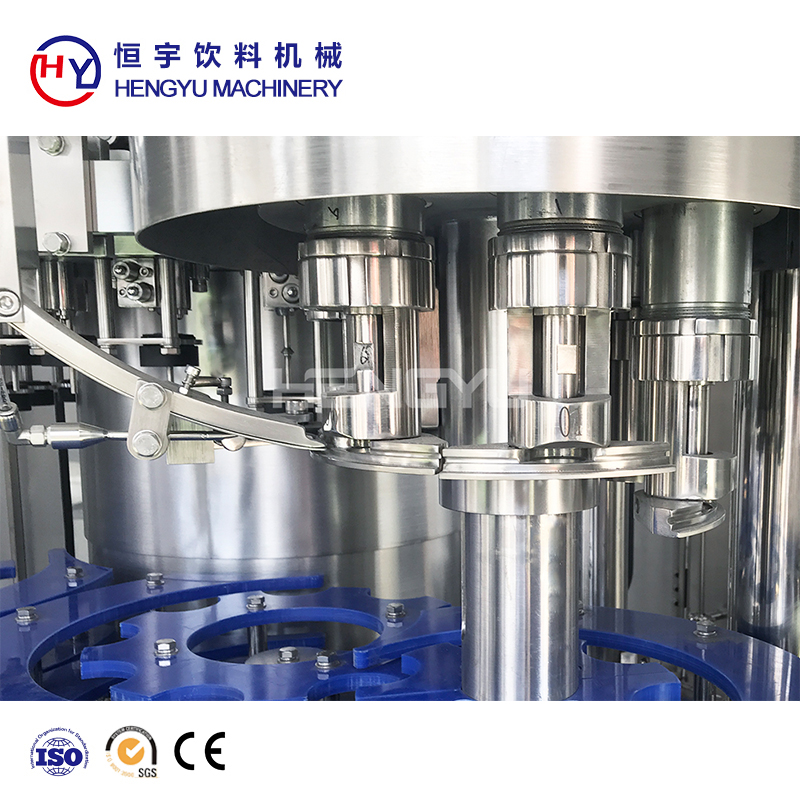
Mechanical Linkage and Timing Accuracy in Filler-Seamer Integration
Precision Gear Trains and Encoder-Driven Cam Systems for Sub-Millisecond Sync
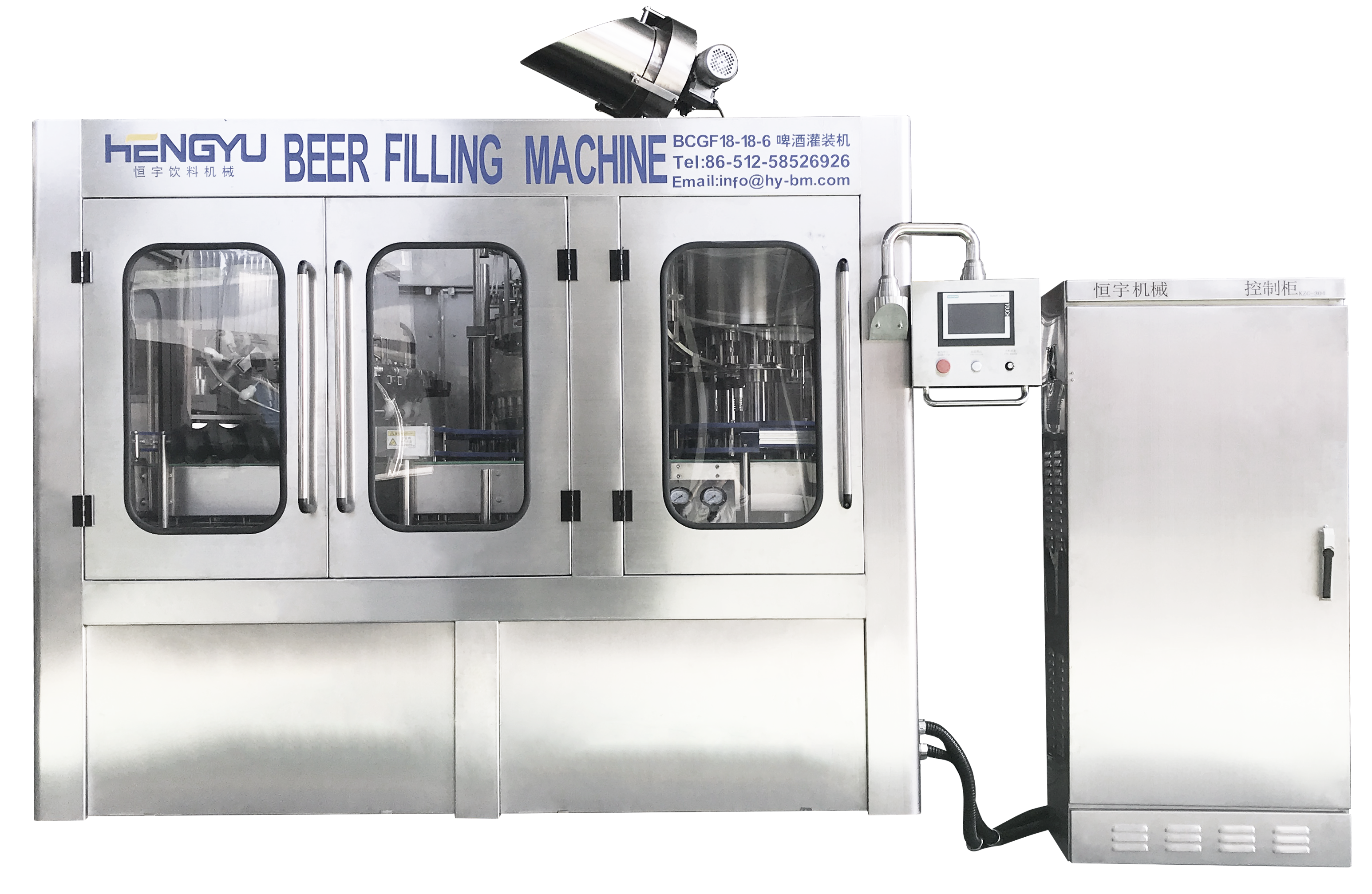
Mechanical linkages in high-speed beer lines rely on precision gear trains—not belts or flexible couplings—to maintain direct, phase-locked motion between filler and seamer turrets. A typical architecture uses hardened helical gears paired with a master encoder on the filler shaft, feeding real-time position data to a digital cam profile in the seamer’s servo drive. This Filler-Seamer Sync system updates position loops every 125 µs, limiting angular error to ±0.02° even at 1,200 containers per minute (CPM). By eliminating elastic wind-up from timing belts or couplings, it ensures seam-head engagement aligns precisely with can arrival. Encoder-driven cam tables map the filler’s lift-and-fill cycle directly to the seamer’s roll-forming sequence, enabling sub-millisecond adjustment of chuck spindle advance. Field data from high-speed breweries show such direct-drive gear-cam systems reduce the standard deviation of seam-initiation timing to just 0.4 ms—well within the window required for hermetic double seams (Packaging Benchmark 2023).
Impact of Mechanical Backlash and Thermal Drift on Synchronization Tolerance
Backlash and thermal expansion are two primary sources of cumulative timing drift. Just 0.05 mm of circumferential backlash in a final drive pinion introduces a 0.3° phase lag between filler valve opening and first-operation seaming roll contact—enough to drop seam overlap below the critical 1.0 mm threshold. Similarly, thermal growth compounds misalignment: cast-iron base plates expand ~0.08 mm per metre per 10°C rise, shifting turret geometry relative to the seamer. On a line running at 1,000 CPM, a 20°C thermal gradient between cold-fill beer and ambient conditions can induce 0.2 mm vertical misalignment—equivalent to 1.2° of rotational timing drift. Leading packaging centers mitigate this using laser-aligned torque-limiting couplings and active gear housing cooling, maintaining synchronization tolerance within ±0.5° across eight-hour shifts. Without these controls, operators must recalibrate every 90 minutes, and loose seam defect rates increase by an average of 1.8 percentage points (Brewery Efficiency Survey 2024).
High-Speed Line Dynamics and Speed Matching for Filler-Seamer Sync
Achieving flawless Filler-Seamer Sync at ultra-high speeds demands dynamic coordination—not just static alignment—between the filler’s output rhythm and the seamer’s closing head movement. The mechanical linkage must sustain sub-millisecond timing despite speed fluctuations common on carbonated beverage lines exceeding 1,200 CPM.
Isobaric Filling Constraints and Seamer Dwell-Time Requirements at 1,200+ CPM
Isobaric filling requires constant counter-pressure to suppress CO₂ breakout, constraining filler valve open/close time to 80–100 ms at 1,200+ CPM. Meanwhile, the seamer needs ≥40 ms of dwell time—the interval the chuck fully engages the can end—to form a hermetic double seam. Zero-backlash gear trains and high-resolution encoders ensure positional handoff accuracy of ±0.5 mm between filler discharge and seamer starwheel pickup. Any misalignment forces premature or shortened dwell, risking seam integrity. Modern servo-driven fillers with adaptive pressure compensation during nozzle retraction—and predictive algorithms that anticipate speed changes—maintain ±0.8° timing accuracy across ramp-up and steady-state operation. Production audits confirm that optimizing speed curves between filler and seamer reduces speed-related defects by 63%, effectively balancing isobaric constraints with mechanical dwell requirements.
Upstream/Downstream Integration Latency: Fill Confirmation to Seam Initiation
From fill-level confirmation to seam initiation, signal latency must be minimized. Delays widen the effective transfer gap and risk off-center seaming head engagement. PLC-controlled systems using real-time Ethernet protocols synchronize the filler’s discharge trigger with the seamer’s master encoder, reducing integration latency to under 2 ms. Conveyor speed, filling station index, and seamer infeed are dynamically linked through closed-loop feedback: if upstream accumulation occurs, the filler pauses discharge while the seamer cycles empty. Advanced monitoring detects drift between fill confirmation and seam initiation and automatically adjusts mechanical phasing—keeping the total lag within 5 ms. This margin is essential for consistent double seam compression at line speeds approaching 1,500 CPM.
Synchronization Variability and Its Impact on Seaming Quality
Correlation Between ±0.8° Timing Deviation and Double Seam Compression Anomalies
A ±0.8° phase deviation between filler and seamer disrupts force distribution during first-operation roll engagement. At 1,200 CPM, this translates to a 0.55 mm linear shift at the roll interface—causing uneven compression, loose seams, cutovers, and insufficient overlap. Seam tightness drops by 12–18%, and dissolved oxygen pickup rises by up to 30 ppb, accelerating beer staling (Industry Packaging Integrity Study, 2022). Because mechanical backlash and thermal drift frequently exceed this threshold, encoder-driven gear trains are not optional—they’re foundational to preserving hermetic integrity.
Real-Time Monitoring: Seam Imaging vs. Acoustic Emission for Early Sync Drift Detection
Optical seam imaging delivers high-fidelity dimensional profiles but suffers from 200–400 ms latency—too slow to catch transient misalignments before defects occur. In contrast, acoustic emission sensors detect subtle deformation signatures in real time, identifying a 0.5° phase shift within 50 ms via spectral analysis in the 100–300 kHz band. This enables immediate servo-based corrections—often before visible seam anomalies appear—reducing spoilage risk by up to 40% compared to imaging-only inspection.
FAQ
What is Filler-Seamer Sync?
Filler-Seamer Sync refers to the synchronization system that ensures precise timing between filler and seamer processes in high-speed beverage production lines.
How does thermal drift affect synchronization in high-speed lines?
Thermal drift causes mechanical misalignment due to temperature-induced expansion, leading to timing deviations and higher defect rates in can seaming.
Why is encoder-driven gear systems preferred over belts or couplings?
Encoder-driven gear systems eliminate elastic wind-up, ensuring sub-millisecond timing precision that belts and couplings cannot achieve.
How do acoustic emission sensors benefit seam alignment?
Acoustic emission sensors detect early synchronization drift in real time, enabling immediate corrections and reducing spoilage risk significantly.