
 CN
CN
How Smart Sensors Revolutionize Real-Time Process Control in NextGen Filling
Monitoring critical parameters: temperature, pressure, fill level, and seal integrity with sub‑millisecond precision
Modern filling lines require control loops that react in under a millisecond. Smart sensors now capture temperature, pressure, fill level, and seal integrity simultaneously—each data point time-stamped with sub-millisecond precision. A food-grade capacitive sensor, for example, measures fill level at 10 k samples/s, detecting a 0.1 mm deviation before over- or under-filling occurs. MEMS-based pressure transducers identify micro-fluctuations in the dosing chamber, triggering instant corrective pulses to servo-driven pistons. Ultrasonic or vision-based seal integrity sensors scan every cap closure in under 5 ms, rejecting defects without slowing line speed. This responsiveness is critical: a 0.5% overshoot on a 20,000-bottle/hour line wastes over 8,000 liters annually. By feeding these parameters into a deterministic fieldbus, systems maintain consistent fill quality across speed ramps—from 100 to 600 containers per minute. Granular, time-synchronized logging also enables precise root-cause analysis, replacing hours of manual inspection with automated forensic diagnostics. One leading beverage producer reduced annual material losses by 12% after upgrading from analog limit switches to multi-parameter smart sensors—shifting from reactive alarms to continuous, high-fidelity monitoring and turning mechanical fillers into real-time, self-correcting assets aligned with Industry 4.0 principles.
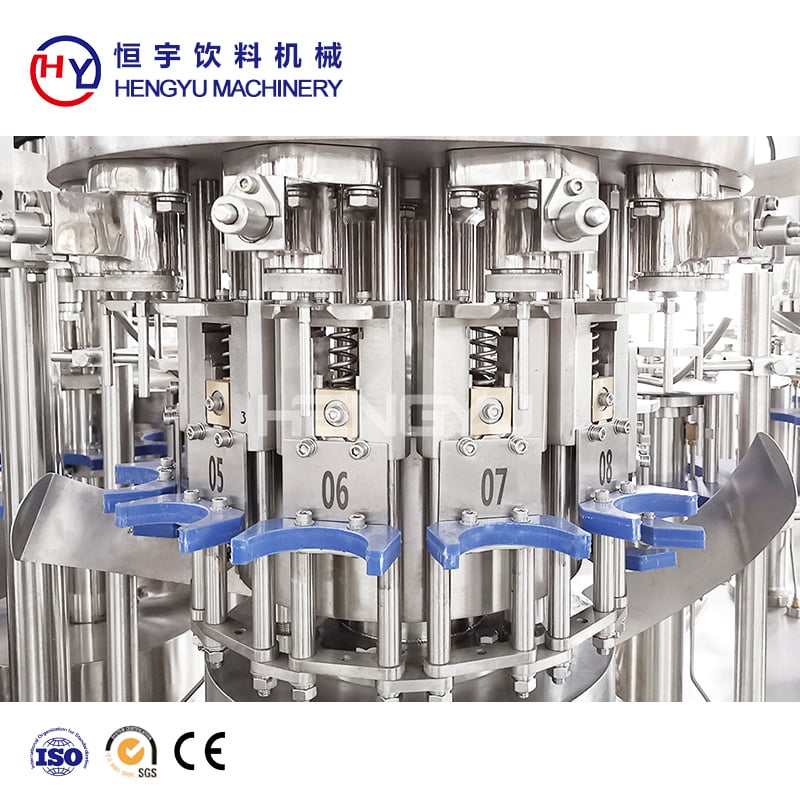
Sensor fusion and AI‑driven analytics for adaptive filling accuracy and <0.5% material waste reduction
Single-sensor feedback suffices for stable recipes, but real-world variability demands sensor fusion. By integrating data from flow meters, load cells, and temperature probes, the control system constructs a dynamic digital twin of the fill process. AI-driven analytics compare live streams against historical models to predict optimal shut-off points—compensating for foam formation, viscosity shifts, or thermal expansion in real time. This closed-loop adaptation consistently achieves material waste below 0.5%. For instance, when ambient temperature rises by 2°C on a high-viscosity sauce line, the system blends load cell trends (indicating gradual density loss) with temperature readings to shorten the fill stroke by 0.8%, preserving net content accuracy. Trials across 12 packaging plants showed an average waste reduction from 1.2% to 0.4% after adopting sensor fusion, as documented in the 2023 Industry Automation Benchmark Report. Reinforcement learning models continuously refine tolerance bands—adjusting for valve seat wear or pump drift—eliminating periodic manual recalibration. Critically, this intelligence runs on edge gateways, preserving sub-millisecond response times unimpeded by cloud latency. The result is adaptive accuracy that directly lowers material cost while strengthening sustainability KPIs—key imperatives in today’s regulated and eco-conscious manufacturing environment.
IoT Integration Enables Predictive Maintenance and Operational Resilience
Vibration, acoustic, and motor current signature analysis for early fault detection in high-speed filling lines
Smart sensors and IoT are redefining predictive maintenance by translating subtle machine behavior into actionable insight. Tri-axial accelerometers detect bearing wear, misalignment, or imbalance patterns weeks before failure. Acoustic sensors capture ultrasonic emissions from valve leaks or pump cavitation—inaudible to human operators. Motor current signature analysis (MCSA) monitors electrical waveforms to identify rotor bar damage or load-induced anomalies in filling drives. These sensor streams feed edge-processing gateways running fast Fourier transforms and envelope analysis, flagging degradation trends in real time. When integrated via IoT platforms, fused data delivers a unified, condition-based view of asset health across entire packaging lines—triggering maintenance only when parameters deviate from learned baselines, not on fixed schedules. This proactive model sustains fill accuracy and prevents cascade failures, delivering the connected, intelligent efficiency central to Industry 4.0.
Case evidence: 42–45% reduction in unplanned downtime via cloud‑connected IoT platforms
Deployments by leading IIoT platform vendors confirm dramatic gains in operational resilience following adoption of cloud-connected predictive maintenance. Across multiple high-speed beverage and pharmaceutical filling sites, centralized analysis of vibration, acoustic, and motor current data correlated with a 42–45% reduction in unplanned downtime within the first year, per the 2023 Industry Reports benchmark. Gains stemmed from eliminating surprise stoppages: algorithms detected bearing degradation, conveyor slippage, and nozzle blockages early enough to schedule repairs during planned changeovers. Replacing calendar-based routines with condition-driven alerts not only avoided costly emergency interventions but extended mean time between failures for rotary fillers and cappers. Cloud architecture enabled continuous model refinement, improving prediction accuracy as the fleet generated more failure signatures. These outcomes demonstrate that transforming sensor data into foresight makes operational resilience a measurable, repeatable outcome—not just an aspiration.
Scalable Connectivity Architecture: Industrial Ethernet, OPC UA, and Secure Cloud Integration
Smart sensors and IoT in next-gen filling machines generate terabytes of time-critical data—demanding a connectivity backbone built for sub-millisecond latency and seamless horizontal-vertical integration. Industrial Ethernet protocols like PROFINET and EtherNet/IP now account for over 70% of new node installations in manufacturing (HMS Networks, 2023), delivering the determinism and throughput required for high-speed filling lines without compromising IT-OT convergence. These networks form the foundational layer for scalable architectures, ensuring every pressure reading, fill-level measurement, and seal-integrity check travels reliably from sensor edge to controller floor.
Building on that deterministic transport, OPC UA (Open Platform Communications Unified Architecture) serves as the universal data-modeling and security framework unifying heterogeneous devices across the filling ecosystem. Conforming to IEC 62541, it embeds mutual authentication, message signing, and AES-256 encryption directly into the communication stack—eliminating the need for bolt-on security gateways. Its platform-independent information models allow fillers’ control systems to expose sensor parameters—temperature, vibration, fill accuracy—in a semantically consistent manner to SCADA, MES, and cloud analytics platforms, enabling true plug-and-produce interoperability without vendor lock-in.
Secure cloud integration extends the architecture beyond the shop floor, transforming raw sensor streams into actionable intelligence. By pairing OPC UA reverse-connect with MQTT brokers and edge-based stream analytics, filling machines push aggregated, anonymized data to cloud data lakes while retaining local decision-making for real-time control loops. This hybrid approach supports predictive maintenance, holistic OEE dashboards, and remote fleet analytics—all within a zero-trust model where every packet is authenticated and encrypted before leaving the plant. The result is a future-proof connectivity framework capable of scaling with growing sensor fleets, new analytics workloads, and evolving cybersecurity threats—without disrupting production.
Regulatory-Ready IoT Adoption in Pharma: Smart Sensors for 21 CFR Part 11 and GMP (Good Manufacturing Practice) Compliance
Audit-trail-enabled sensor data streams, electronic signatures, and immutable time-stamped logs
Smart sensors in next-gen pharmaceutical filling machines capture high-frequency data streams—recording fill volume, seal integrity, and environmental conditions with sub-millisecond precision. These IoT-connected devices embed unique electronic signatures into each data packet, generating immutable, time-stamped logs that satisfy 21 CFR Part 11 requirements for trustworthy electronic records and signatures. The resulting audit trail links every operator action and sensor reading to a secure, tamper-proof history—enabling full traceability from raw material to packaged dose. By replacing paper-based logs and manual transcription, this automation reduces human error and provides real-time visibility into compliance status. Such robust data integrity strengthens adherence to Good Manufacturing Practice (GMP) and accelerates Industry 4.0 transformation, as automated reporting and remote oversight simplify regulatory inspections and significantly lower documentation overhead.
FAQs
What is the key benefit of using smart sensors in next-gen filling machines?
Smart sensors enhance precision, reduce material waste, and enable real-time process control by capturing critical parameters like temperature, pressure, and fill levels with sub-millisecond accuracy.
How do AI-driven analytics improve filling accuracy?
AI-driven analytics compare live data to historical models, enabling real-time adjustments for variables like foam formation and temperature changes, leading to material waste reduction below 0.5%.
What role does IoT play in predictive maintenance?
IoT enables predictive maintenance by integrating sensor data for early fault detection and condition-based monitoring, reducing unplanned downtime and improving operational efficiency.
How does OPC UA benefit next-gen filling machines?
OPC UA unifies data from diverse systems in a secure, standardized manner. This ensures interoperability, real-time decision-making, and seamless integration with SCADA, MES, and cloud platforms.
How do smart sensors ensure regulatory compliance in pharmaceutical filling?
Smart sensors generate immutable, time-stamped logs with electronic signatures, meeting 21 CFR Part 11 and GMP requirements for data integrity and traceability.
Table of Contents
- How Smart Sensors Revolutionize Real-Time Process Control in NextGen Filling
- IoT Integration Enables Predictive Maintenance and Operational Resilience
- Scalable Connectivity Architecture: Industrial Ethernet, OPC UA, and Secure Cloud Integration
- Regulatory-Ready IoT Adoption in Pharma: Smart Sensors for 21 CFR Part 11 and GMP (Good Manufacturing Practice) Compliance
-
FAQs
- What is the key benefit of using smart sensors in next-gen filling machines?
- How do AI-driven analytics improve filling accuracy?
- What role does IoT play in predictive maintenance?
- How does OPC UA benefit next-gen filling machines?
- How do smart sensors ensure regulatory compliance in pharmaceutical filling?