
 CN
CN
Why Upgrade? Addressing Throughput and Consistency Bottlenecks
The Limitations of Semi-Automatic Lines: Manual Intervention, Idle Time, and Output Variability
Semi-automatic glass bottle filling lines rely heavily on operator presence at every station—manual loading, cap placement, and container transfer introduce frequent unplanned interruptions. Jams, supply replenishment, and subjective adjustments fragment production flow, making output unpredictable. Fill volumes drift as operators tweak settings on the fly, and cap torque fluctuates with fatigue—directly compromising shelf life and consumer safety. Changeovers consume up to 30% of a shift due to mechanical, hand-adjusted station reconfigurations, tying up personnel and equipment. Data logging remains rudimentary: basic counters rarely integrate with manufacturing execution systems (MES), blocking real-time performance analysis and traceability. As a result, overall equipment effectiveness (OEE) typically stagnates between 55% and 65%, and throughput caps at 60–120 bottles per minute (bpm) for standard 330 ml glass containers. The SemiAuto to Rotary Production Upgrade eliminates these constraints by replacing intermittent manual handling with a fully automated, continuous-motion architecture.
How Rotary Indexing Enables True Continuous Flow and Eliminates Cycle Downtime
A rotary filling line moves bottles on a continuously rotating carousel, enabling simultaneous operations—filling, capping, and labeling—along the arc without stopping. Servo-driven starwheels index each container smoothly into position, eliminating the micro-stops inherent in semi-automatic indexing. Because the line never halts between cycles, idle time nearly vanishes. Throughput jumps to 200–450 bpm for 330 ml glass bottles, scaling with the number of filling heads. Servo control enables recipe changes at the touch of a screen, reducing changeover time from hours to minutes and supporting rapid format switching. Fill precision improves dramatically, with coefficient of variation (CV) consistently below ±0.8%, minimizing product giveaway and rework. Glass breakage rates fall with fewer manual touchpoints, and OEE regularly exceeds 85%. This shift transforms a stop-start bottleneck into a predictable, high-speed stream that scales responsively with demand.
SemiAuto to Rotary Production Upgrade Glass Bottle Line Efficiency: Speed, Precision, and Quality Gains
Speed Leap: From 60–120 bpm to 200–450 bpm for Standard 330ml Glass Bottles
The core throughput limitation of semi-automatic lines lies in their operator-paced, stop-start indexing—no amount of operator skill can overcome this structural ceiling, which caps output at ~120 bpm for standard 330 ml glass. A rotary system dissolves that ceiling by converting sequential, station-by-station processing into parallel, continuous motion. Bottles move seamlessly through the carousel, with all primary operations occurring simultaneously. This architectural shift routinely delivers 200–450 bpm—often tripling capacity. Industry benchmarks confirm this transition multiplies productivity by a factor of three (Packaging Machinery ROI Report, 2024), allowing producers to meet peak-season demand without resorting to costly overtime or quality-compromised multi-line operations.
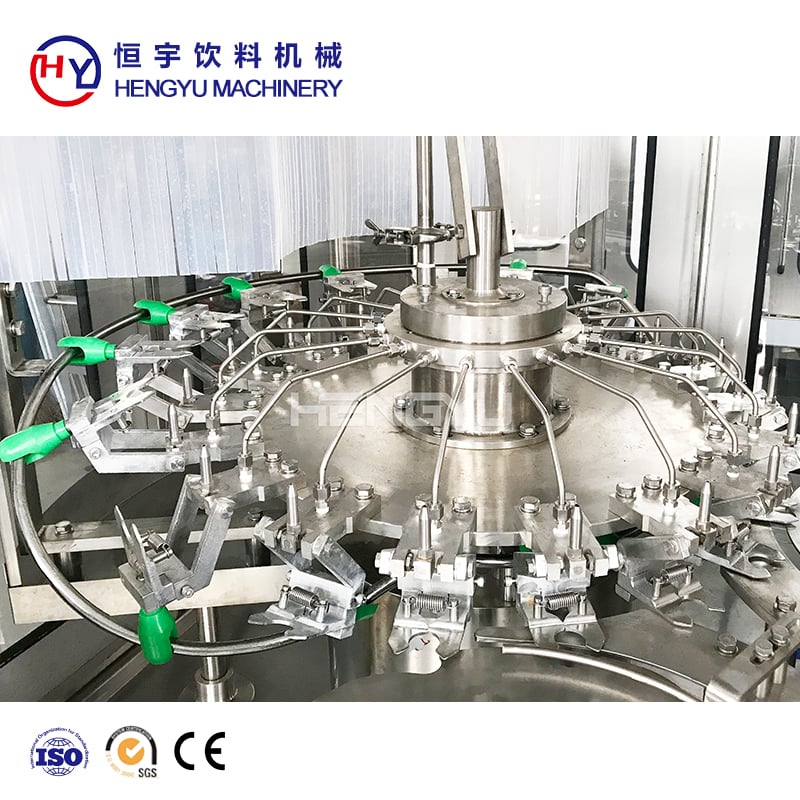
Precision Engineering: Servo-Driven Fillers and Vision-Guided Capping Reduce Fill Volume CV to <±0.8%
Speed without precision erodes margin—not value. Rotary lines deploy servo-driven filling valves that respond to real-time feedback in milliseconds, achieving fill volume CVs under ±0.8%. Unlike piston or gravity fillers in semi-auto setups—whose accuracy drifts with temperature, wear, or manual calibration—these systems maintain repeatability across shifts and seasons. Vision-guided capping adds another layer of control: every closure is inspected for alignment and torque before release, rejecting defective seals inline. The financial impact is direct and measurable. Producers report significant reductions in product giveaway—translating to thousands of dollars saved annually across millions of bottles—while also lowering rework, customer complaints, and recall risk.
Labor Optimization and Operational Cost Reduction
A SemiAuto to Rotary Production Upgrade fundamentally reconfigures labor demands. Where a semi-automatic line requires four to six operators for loading, fill monitoring, and cap placement, a modern rotary system with integrated infeed and discharge operates reliably with just one or two skilled technicians overseeing controls and preventive maintenance. This shift cuts direct labor costs by 60–70% per shift—$120,000–$180,000 annually for a mid-tier beverage operation (Packaging World, 2023). Remaining staff are cross-trained in line analytics and quick-changeover protocols, evolving from task-specific laborers into multi-functional assets who reduce reliance on overtime and temporary staffing. The elimination of manual loading pauses and redundant visual checks compresses labor-per-bottle cost significantly. Coupled with automated fault detection that prevents jams and fill errors, rework and rejected product drop sharply—further lowering operational overhead and reinforcing ROI.
ROI Analysis: Balancing Upfront Investment Against Long-Term Efficiency Gains
CAPEX Range ($350K–$1.2M) vs. Real-World Payback (14–22 Months) in Mid-Tier Beverage Production
Capital investment for a SemiAuto to Rotary Production Upgrade ranges from $350,000 for a basic monobloc configuration to $1.2 million for a fully integrated, servo-driven line with vision inspection (Packaging Machinery ROI Report, 2024). Though substantial, payback in mid-tier beverage facilities—running 12–16 hours daily—consistently falls within 14–22 months. This rapid return stems from three interlocking gains: labor cost reduction of up to 60%, a threefold throughput increase (e.g., 80 → 240 bpm), and precise fill control that slashes giveaway. Scalability further strengthens the case: rotary platforms accommodate new bottle formats with minimal downtime, preserving asset value over a typical 10-year lifecycle. The initial outlay is not an expense—it’s a strategic lever unlocking sustained revenue growth and cost discipline.
Hidden ROI Drivers: Reduced Reject Rates, Lower OEE-Related Downtime, and Scalable Capacity
Beyond headline metrics, the most compelling ROI emerges in less visible but high-impact areas. Automated inspection and servo-guided capping cut reject rates from 3–5% to under 0.5%, directly reducing material waste and reprocessing labor. Mean time between failures (MTBF) increases significantly—rotary systems avoid the chronic jams and overfill errors common in semi-automatic machines—lifting OEE by 8–12 percentage points (Packaging Efficiency Benchmark, 2023). More uptime means more output per shift, effectively converting fixed labor costs into higher marginal returns. Finally, scalability is intrinsic: a rotary line can absorb 50% higher demand simply by extending runtime or adding heads—no new line required. These cumulative advantages often deliver a total 3-year ROI exceeding 200%, making the upgrade financially robust even under conservative assumptions.
FAQs
What is the main advantage of switching to a rotary production line?
The primary advantage lies in the ability to achieve continuous flow operation, drastically increasing throughput (up to 450 bpm for standard 330 ml bottles) and reducing downtime.
How does servo-driven filling improve precision?
Servo-driven fillers respond to real-time feedback, ensuring consistent accuracy with fill volume coefficients of variation (CV) below ±0.8%. This decreases product loss and enhances quality assurance.
What cost savings can be achieved with this upgrade?
Labor costs can drop by 60–70% per shift, and material waste is reduced due to automated processes. Combined, these savings contribute to a ROI within 14–22 months.
What is the typical payback period for a SemiAuto to Rotary Production Upgrade?
For mid-tier beverage facilities, the payback period is roughly 14–22 months, depending on the system’s configuration and operating hours.
How scalable are rotary systems for future growth?
Rotary systems are highly scalable. They can accommodate increased demand by extending runtime or simply adding additional filling heads, eliminating the need for new production lines.
Table of Contents
- Why Upgrade? Addressing Throughput and Consistency Bottlenecks
- SemiAuto to Rotary Production Upgrade Glass Bottle Line Efficiency: Speed, Precision, and Quality Gains
- Labor Optimization and Operational Cost Reduction
- ROI Analysis: Balancing Upfront Investment Against Long-Term Efficiency Gains
-
FAQs
- What is the main advantage of switching to a rotary production line?
- How does servo-driven filling improve precision?
- What cost savings can be achieved with this upgrade?
- What is the typical payback period for a SemiAuto to Rotary Production Upgrade?
- How scalable are rotary systems for future growth?