
 CN
CN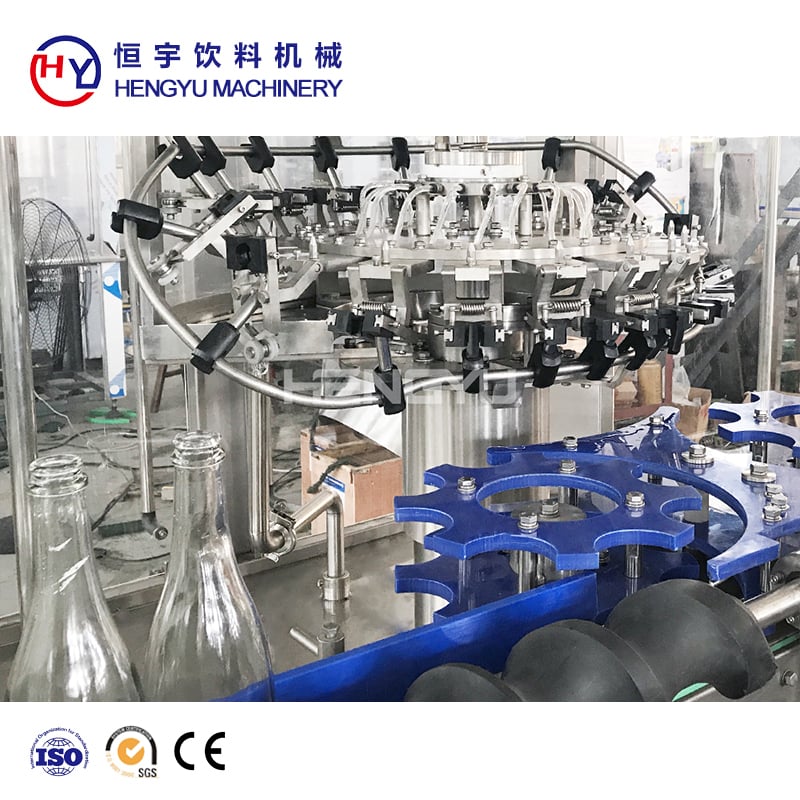
How Counter-Pressure Filling Preserves Carbonation in Glass Bottles
The CO₂ Loss Problem in Conventional vs. Counter-Pressure Filling
When carbonated beverage flows into a bottle under atmospheric pressure, the sudden pressure drop triggers rapid CO₂ breakout—causing foam, inconsistent fill levels, and measurable carbonation loss. Conventional gravity or atmospheric fillers operate at ambient pressure, creating a large differential that drives dissolved CO₂ out of solution. Industry data shows these methods retain only ~78% of original carbonation, with losses exceeding 20% (Beverage Production Quarterly, 2023). Foam management further constrains line speed and increases waste.
Counter-pressure filling eliminates this issue by pressurizing the empty glass bottle with CO₂ before liquid entry. A sealed nozzle raises internal pressure to match that of the beverage in the filler bowl—typically 3–5 bar. Once isobaric equilibrium is achieved, the liquid flows smoothly down the bottle wall or via bottom-fill tube with minimal turbulence. This preserves up to 98% of dissolved CO₂, reduces waste by 12–15% per run, and delivers consistent effervescence and fill accuracy.
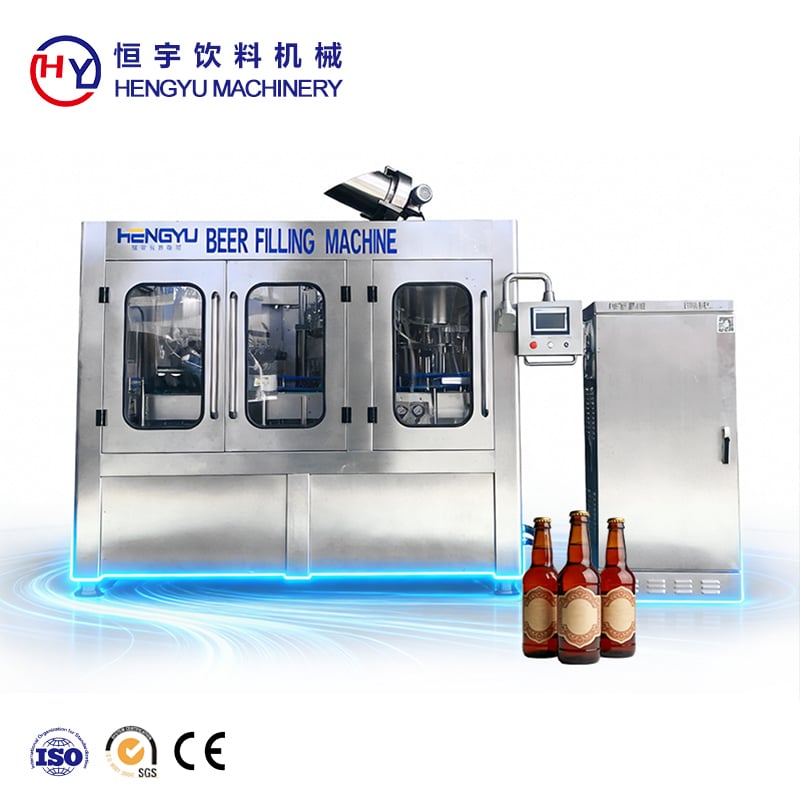
Core Principle: Isobaric Equilibrium and Pressure Balancing During Fill
The foundation of counter-pressure filling is maintaining equal pressure inside the bottle and filler bowl throughout the process—a condition known as isobaric equilibrium. After an airtight seal forms between bottle and nozzle, CO₂ purges residual air and elevates internal pressure to match the carbonated liquid’s headspace pressure. Only then does the fill valve open, allowing laminar flow without foaming or degassing.
Fill rate is precisely controlled to avoid agitation, and a calibrated snifting step releases pressure gradually before capping. Sudden decompression would otherwise trigger CO₂ release and foam. By eliminating pressure gradients, the isobaric method keeps CO₂ stably dissolved—preserving the sensory “bite,” mouthfeel, and shelf-stable fizz consumers expect from premium glass-bottled beverages.
Pre-Evacuation and Controlled Venting to Suppress Foam and CO₂ Escape
Pre-evacuation—or CO₂ purging—removes ambient air and oxygen before pressurization, stabilizing the bottle environment and reducing nucleation sites that initiate premature CO₂ escape. Once pressurized, a metered vent system continuously releases displaced gas from the headspace at a rate synchronized with fill speed. Too-rapid venting induces turbulence; too-slow causes overpressure and extended cycles. Optimized venting paired with fast fill cycles (e.g., 250 ms) cuts CO₂ escape by 62% versus slower 400 ms cycles (2022 Packaging Technology Report), while also minimizing oxygen ingress.
Fill Tube Design, Insertion Depth, and Venting Rate Optimization
Fill tube geometry critically influences flow behavior and carbonation retention. A long, slender tube supports laminar flow—but insertion depth must be carefully tuned. Tubes terminating too close to the bottle base create turbulent impact and fountain effects that strip CO₂; those positioned just above the rising liquid surface minimize splashing. Some systems use floating ball valves that rise with fill level for dynamic positioning.
Key design levers include:
- Tube diameter and length: Smaller diameters reduce turbulence but may limit throughput.
- Vent orifice control: Variable-area vents allow real-time adjustment to match fill dynamics and prevent pressure spikes.
- Tri-variable automation: Systems that coordinate fill speed, venting, and counter-pressure in real time achieve carbonation consistency within ±0.7%—98.3% accuracy (2024 Brewing Equipment Review).
These refinements enable high-speed operation (20,000 bph) while holding CO₂ loss below 5%.
Why Longer Fill Tubes Can Increase CO₂ Loss Despite Improved Sealing
While longer fill tubes enhance sealing integrity deeper in the bottle, they introduce unintended trade-offs. Increased tube length extends the liquid’s path under pressure—amplifying shear forces and flow turbulence that destabilize dissolved CO₂. Higher friction also demands faster fill speeds to maintain cycle times, further aggravating agitation and foam formation. Pilot trials found a 20% increase in tube length raised CO₂ loss by 8–12% during filling (2022). In practice, superior carbonation retention often comes from balancing seal quality with optimized venting and moderate tube length—not maximizing depth alone.
Quantifying Carbonation Retention: Real-World Performance Data
Counter-pressure systems consistently deliver 96–99% dissolved CO₂ retention in glass bottles—versus 70–85% for conventional fillers. This difference directly impacts shelf life: one major beverage brand extended product freshness by 8–12 weeks after switching to isobaric technology, largely due to reduced oxygen pickup and CO₂ loss. Sensory testing confirms functional consequences—a 0.1-volume CO₂ deficit lowers consumer-rated “bite” and freshness by 1.5 points on a 10-point scale (2023 high-speed line analysis).
Dissolved oxygen (DO) levels tell a parallel story: counter-pressure fills average <50 ppb DO, while non-isobaric methods introduce 200–500 ppb—accelerating oxidation and flavor degradation. These performance gaps are commercially decisive: reducing CO₂ loss by just 0.5 volumes across a dedicated line saves mid-sized operations over $120,000 annually in carbonation costs alone, while safeguarding brand reputation against returns and complaints.
FAQ
What is counter-pressure filling?
Counter-pressure filling is a beverage packaging technique where empty bottles are pressurized with CO₂ prior to liquid filling, balancing internal pressure with the carbonated beverage to minimize CO₂ loss.
How does counter-pressure filling improve carbonation retention?
By achieving isobaric equilibrium and eliminating pressure gradients, counter-pressure filling preserves up to 98% of dissolved CO₂ compared to the ~78% retention rate of conventional methods.
What is isobaric equilibrium?
Isobaric equilibrium refers to the state wherein the internal pressure of the bottle matches the pressure of the filler bowl, allowing smooth liquid entry without foaming or CO₂ breakout.
Why is tube design important during counter-pressure filling?
The design and placement of the fill tube directly impact flow behavior and carbonation retention. Optimal insertion depth and tube geometry minimize turbulence, preserving CO₂.
What is pre-evacuation and why is it necessary?
Pre-evacuation involves removing ambient air and oxygen from the bottle before pressurization to stabilize conditions and reduce the risk of premature CO₂ loss and nucleation.
How does counter-pressure filling extend shelf life?
By reducing oxygen ingress and preserving carbonation, counter-pressure filling enhances product freshness, extending shelf life by 8–12 weeks for many beverages.
Table of Contents
-
How Counter-Pressure Filling Preserves Carbonation in Glass Bottles
- The CO₂ Loss Problem in Conventional vs. Counter-Pressure Filling
- Core Principle: Isobaric Equilibrium and Pressure Balancing During Fill
- Pre-Evacuation and Controlled Venting to Suppress Foam and CO₂ Escape
- Fill Tube Design, Insertion Depth, and Venting Rate Optimization
- Why Longer Fill Tubes Can Increase CO₂ Loss Despite Improved Sealing
- Quantifying Carbonation Retention: Real-World Performance Data
- FAQ